
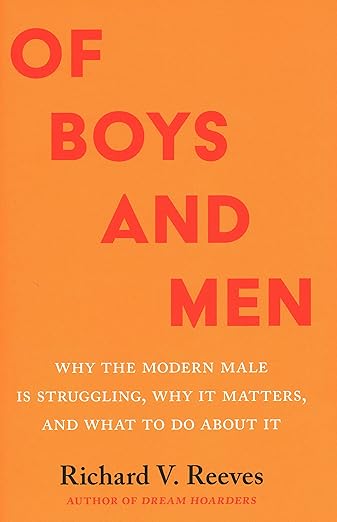
It’s easy to slap shallow Left or Right political explanations and solutions on the struggles men are facing today. If we really want to help men and women, we have to leave the politics behind. In Of Boys and Men, Richard Reeves explains why.
- In education: Boys underperform in school and women now earn 60% of bachelor’s degrees, a near reversal from fifty years ago.
- In mental health: Men are three to four times more likely to die by suicide than women.
- In the workplace: “Male jobs have been hit by a one-2 punch, of automation and free trade. Machines pose a greater threat to working men than to women for two reasons. First, the occupation’s most susceptible to automation are just more likely to employ men…. By contrast, women make up most of the workforce in relatively automation-safe occupations, such as healthcare, personal services, and education.” (21)
- In the family: “In 2020, one in five children (21%) were living with a mother only, almost twice as many as in 1968 (11%).” (41)
While Reeves affirms the progress women have made in many areas, he contends we can and should do two things at once—help women and help men.
In fact with more and more women carrying the burden of being both primary breadwinners and primary childcare providers, often the best thing we can do for women is to help the men in their lives get decent jobs and affirm their role in the family.
One problem is that both Left and Right have gone to extremes and politicized the issue, while neither does much about it. “Far away from the front lines of the culture war, the real-world problems of boys and men go largely unaddressed” (129).
Many on both sides, for example, are science deniers. “Many conservatives deny the environmental science of climate change. But many progressives deny the neuroscience of sex differences…. For many progressives, it is now axiomatic that sex differences in any outcomes or behaviors are wholly the result of socialization. . . . But this is simply false. Men do not have a higher sex drive just because society valorizes male sexuality, even if it does. They have more testosterone. Likewise aggression… To be fair, there are some reasonable concerns about how this science will be used…. Natural differences between men and women have often been used to justify sexism. This is mostly an outdated fear. In recent years, most of the scientists identifying natural differences have, if anything, tend to do stress the superiority of women.” (111)
The solution is not, says Reeves, to turn back the clock. That ship has sailed, that train left the station, that rocket blasted off. Our economy has been restructured so dramatically in the last half century that, with few exceptions, families cannot thrive on a single income.
Reeves proposes a variety of concrete, workable changes. Here are just a few of his ideas:
- In education: Since boys take longer than girls to develop mentally and socially, gradually shift so that boys start kindergarten a year after girls. Many parents already do this so their children will be more athletically developed (and so have a bigger chance of success) in high school and college.
- In the workplace: With traditionally male jobs continuing to fade away, and with jobs on the rise in health, education and administrative, let’s give more emphasis to recruiting and hiring men. And all of us need to stop thinking male nurses are failed doctors or somehow effeminate.
- In the family: We need to affirm that dads still matter especially in their roles as protectors and teachers. Research shows that fathers really come into their own when kids hit adolescence–helping them evaluate risks, navigate what it means to stand on their own feet, and give them confidence as they make their way in the world. Reforming the child support system and paid leave policies can also be key.
It’s time to quit fighting battles that no longer exist, to quit exploiting issues to score political points, and start working together to help everyone.
