
Why are Americans so at odds with each other? Why have so many people entrenched themselves in opposing camps, viciously vilifying each other? What has turned us into a nation of Us vs. Them?
Is cable news responsible? Did the Russians do it? Does it go back to Newt Gingrich or the Robert Bork confirmation?
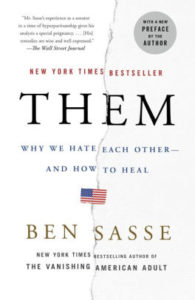 In his book, Them, Senator Ben Sasse has a very unpolitical answer. It’s because, he says, we are lonely. We have fewer friends. We are more disconnected from our communities. So we grasp for a group to feel part of, to identify with. More and more that manifests itself in our political and social identities.
Since World War II single-person households have tripled to 26 percent. Technology has also pushed us into self-reinforcing corners where we just don’t encounter people as people who might have differing views. Other significant factors are at work as well.
Yes, cable news and radio talk showmen and show women have taken advantage of our situation. And yes, the Russians have fanned the flames too with more than 50,000 Russian-linked Twitter accounts fueling outrage by sending automated messages on both sides of issues. But these only feed on a pre-existing condition.
What’s the cure for our illness? The last half of the book offers several worthwhile remedies, from setting tech limits in our personal lives to building into a neighborhood or community to re-educating ourselves on how democracy works and what it stands for.
Sasse regularly says the book is not political in the sense of party politics or hot-button issues. He is right. The book is social and personal. When he does touch on political examples, he is to be commended for being very evenhanded–criticizing and praising as appropriate both right and left, both politicians and journalists, both Republicans and Democrats. Sasse models how we can treat each other as human beings, as fellow Americans who deserve our listening ear and our respect.
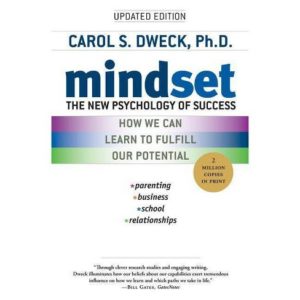 Generally I shy away from self-help and especially positive thinking books. This book, however, does not simply say, “Think good thoughts, not bad, and all will be well.” The main proposal is more substantive and based on research that has helped not just athletes but also students, teachers, business people, parents, and writers.
 In addition, Dweck seems to imply that mindset is context-free. It doesn’t matter what your circumstances, background or social setting are. The growth mindset works all the time everywhere for everyone. I would have liked more than anecdotal evidence on how this paradigm is or could be effective in underresourced communities. She does offer qualifications a few times, saying not everyone can become a Beethoven or a Michael Jordan but that all can improve. Still the breathless enthusiasm of a true believer permeates the book.
 So what’s the central idea the book deals with? What would it be like to live a different version of your life, to follow a different key choice you made that would lead you down a different path? Yes, that’s not entirely new, but its an important idea, one that the book makes you think about.