
“Yes, I’d like to be better at talking to people. But I always blank out. What do I say?”
The beauty is we don’t have to say much at all. Why? Because most people want the opportunity to talk about themselves. All we have to do is ask them.
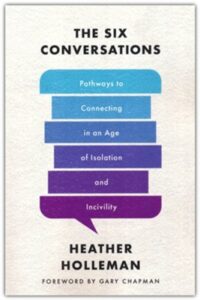
In my last post I mentioned Holleman’s four mindsets that prepare us for talking to others. In The Six Conversations, she also offers (not surprisingly) six types of questions we can ask that largely cover the scope of our lives. While she gives dozens of examples with excellent advice on how to use them, here a few of the sorts of questions she suggests.
 Social
◊ How are things going with your [roommate, parents, siblings]?
◊ If you could have dinner with anyone, past or present, who would it be?
◊ What upcoming plans do you have with friends?
Emotional
◊ What’s made you grateful recently?
◊ What are you looking forward to?
◊ Wow. That’s a big deal. How did you feel about that?
Physical
◊ What have you been doing to relax lately?
◊ What restaurants/new meals have you tried lately?
◊ Was that [recent experience] refreshing or draining for you?
Cognitive
◊ What have you been learning about or thinking about lately?
◊ Who else have you talked to about these ideas? [social]
◊ How do those ideas make you feel? [emotional]
◊ Have those ideas made you think about doing anything different? [volitional]
Volitional
◊ In light of your [news, concern, complaint, problem, opportunity], what choices do you have?
◊ What’s your next step?
◊ Do you have any goals you are working on? Or as a friend recently asked me, “What big goals would you like to accomplish before your kids take away your car keys?” (!)
Spiritual
◊ What’s your spiritual journey been like?
◊ What spiritual traditions do you resonate with?
◊ What kind of spiritual environment did you grow up in?
 To keep great conversations and relationships growing, it’s key to be nonjudgmental, to ask follow-up questions, and not be too quick to give our perspective.
My Three-Question Starter Kit
I keep reviewing this list so the questions become more second nature, but if you want just three to remember, here’s the ones I’ve used:
◊ What’s the story behind [your pet, the college you picked, your interest in ____, etc.]?
◊ What surprised (excited, disappointed) you about [your weekend, the test, the trip, etc.]?
◊ Before we go, what else would you like me ask that you haven’t had a chance to talk about yet?
Holleman has so much more to offer in her wise, practical book which can lead us out of the isolation and polarization we’ve felt. If we can stay curious and believe the best about others, we may not only help others be less lonely, we may also help ourselves.
—
Giraffe image by Christine Sponchia from Pixabay
Friends image by Eva Michálková from Pixabay
 ♦ Reengage with lifelong friends. Admittedly it can be hard to make new friends. An easier but still very fruitful path might be to renew connections with old friends near and far. In recent years I’ve deliberately increased the emails to, calls and zooms with, and visits to several longstanding friends. Some I’ve had spotty contact with over the years, and some I hadn’t seen in decades. But I’ve so enjoyed the results of more regular connection with all of them.
  In his book
  Grant believes that we will be better off if we think more like scientists (but he’s willing to reconsider!). They actually get excited when they find out they are wrong because this means they may have discovered something new. By realizing they were wrong, scientists in the 20th century alone have discovered vitamins, cosmic rays, insulin, atomic nuclei, the polio vaccine, quasars, and much more.*
 The most effective negotiators and debaters, as described by Adam Grant in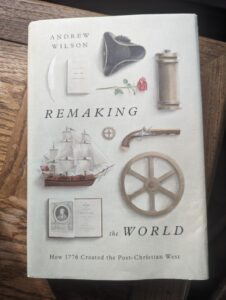
 Wilson closes with three Christian themes from the 1770s to help navigate the weird world that decade has bestowed on us.
 My grandson was reading
 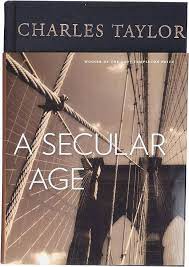 Finally, I pay attention to books that are referenced in more than one book I’ve read. The one that has risen to the top in recent years is A Secular Age by Charles Taylor. The book came out in 2007, and I have read a half dozen different books which make major use of Taylor’s framework and ideas. I confess that I have delayed diving into it because it is almost 900 pages and probably not the easiest read. But I think the time has come.
 Take what Paul says in his letter to the Galatians, for example. It’s a well-known verse often referenced in these discussions. “There is neither Jew nor Gentile, neither slave nor free, nor is there male and female, for you are all one in Christ Jesus” (Gal 3:28). This comes in the middle of a letter that is about making sure Gentiles are treated as full members in the body of Christ, not as second-class Christians. Law shouldn’t divide us, Paul says. Rather grace should unite us.
 Paul’s passionate argument in Galatians calls on all of us to seriously ask questions such as, “How can we all proactively do more? What can we do to make sure that the women in our congregation are growing in Christ, learning more of his grace, growing in their love for God and others? Are there practical changes we can implement that will aid and encourage all groups (but especially those who may be sidelined, because that is Paul’s point) to more fully use their gifts for the building up of the body of Christ? How can we make sure the talents, experiences, and opinions of women are appreciated, that their dignity as people in the image of Christ is affirmed? In this context, how can we look to the interests of others first rather than our own (Phil 2:3-4)?”
