
My mom and dad offered me a wonderful model of married life (as I wrote here). They led our family as partners. Interestingly, my dad (though not a religious person) nonetheless related to my mom in a way that I later found was very consistent with a biblical perspective. And what did I find?
At the very beginning, Genesis 1 offers this picture:
So God created mankind in his own image, in the image of God he created them; male and female he created them. (1:27)
 Humanity, male and female, is created in God’s image. This is emphasized by repeating it in three slightly different ways. Together we bear God’s image. And what does it mean to do that? The answer is in the very next verse:
God blessed them and said to them, “Be fruitful and increase in number; fill the earth and subdue it. Rule over the fish in the sea and the birds in the sky and over every living creature that moves on the ground.” (1:28)
The image of God is not a character trait (like kindness) nor an innate capacity (like consciousness). Rather it is a role, a responsibility. God calls us to be his priests in the cosmic garden he has just made. We are to be his representatives, his vice regents for the world he has created. And note how this is to be done! Men and women are to rule together—“God blessed them and said to them, ‘…Rule over…’” They are to be a team.
This joint project, tragically, was bent by sin. The result was a disruption of God’s original design in two ways. First, instead of harmoniously ruling jointly, husbands would rule over women (3:16). Second, instead of enjoying their rule over “every seed-bearing plant on the face of the whole earth” (1:29), “through painful toil you will eat food from it all the days of your life” (3:17).
God’s project over and over through the Bible has ever since been to undo the effects of sin by restoring our relationship with him, with each other, and with nature. The primary means for achieving this was through the person and work of Christ (Ephesians 2:8-10, 13-16).
Much could be said about this theme throughout the Old and New Testaments, but consider just one remarkable passage from Paul. He writes, “The wife does not have authority over her own body but yields it to her husband. In the same way, the husband does not have authority over his own body but yields it to his wife” (1 Cor 7:4). In the new humanity that Christ creates, the effects of the fall are reversed so that husbands don’t only rule over wives. They rule together, over each other.
This would have blown the minds of the patriarchal world of Paul’s day. That’s just not how Romans, Greeks, or Jews commonly thought. Paul was instead calling on his readers to return to God’s original design of Genesis 1. And we shouldn’t make the mistake of thinking that such mutuality only concerned this one aspect of marriage. When introducing how husbands and wives should relate, he offers a very broad instruction to both, “Submit to one another out of reverence for Christ” (Ephesians 5:21).
“Ephesians 5? The Ephesians 5 which notoriously says wives should submit to their husbands, you’re going to tell me that that Ephesians 5 is about mutuality and about ruling together?” I do in fact have a few more things to say about Ephesians 5. That will be my next installment in this series.
—
St. Louis Botanical Garden image by Andrew T. Le Peau.
 But there’s something else you should know about my dad. He was a confirmed bachelor for forty-six years. He had decided he would not get married because he had never seen a happily married couple. And as he told us, the reason for the unhappiness was always money.
  Extravagance wasn’t the lesson I got from this episode or from watching my parents for decades. After all, they had both lived through the Depression, and frugality was baked into my DNA.
  I also wrote on how Schaeffer spoke prophetically about one of the most pressing needs that the church has today—showing love to each other. If you’d like to see it, just
  Social
 To keep great conversations and relationships growing, it’s key to be nonjudgmental, to ask follow-up questions, and not be too quick to give our perspective.
 ♦ Reengage with lifelong friends. Admittedly it can be hard to make new friends. An easier but still very fruitful path might be to renew connections with old friends near and far. In recent years I’ve deliberately increased the emails to, calls and zooms with, and visits to several longstanding friends. Some I’ve had spotty contact with over the years, and some I hadn’t seen in decades. But I’ve so enjoyed the results of more regular connection with all of them.
  In his book
  Grant believes that we will be better off if we think more like scientists (but he’s willing to reconsider!). They actually get excited when they find out they are wrong because this means they may have discovered something new. By realizing they were wrong, scientists in the 20th century alone have discovered vitamins, cosmic rays, insulin, atomic nuclei, the polio vaccine, quasars, and much more.*
 The most effective negotiators and debaters, as described by Adam Grant in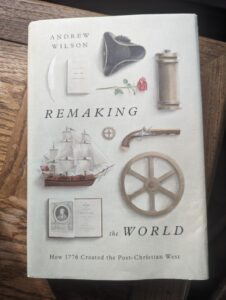
 Wilson closes with three Christian themes from the 1770s to help navigate the weird world that decade has bestowed on us.