
“Be an adult. Quit your whining. Grow up.”
Jordan Peterson is the crusty, old coach who does not tolerate excuses, lack of effort, or stupid choices. He expects the best from you and won’t settle for anything less—not because he needs another victory but because he wants the best for you.
 Listening to him read his book, 12 Rules for Life, you hear how he’s fed up with parents who coddle and refuse to correct their children, with people who won’t take care of their own health, with those who expect only good things in life and are surprised when bad things happen.
Judging by the sales of his books and views on YouTube, people seem to love his no-nonsense lectures—even when he’s shaking a finger at them. In an age when no one seems to know what’s right or wrong (or doesn’t believe in such things), how reassuring it is to hear from someone who confidently tells us exactly what to do.
Fortunately, Peterson has much wisdom to offer—yes, common sense.
- If friends are having a bad influence on you, break the relationship. Instead, find people who will help you in life.
- Tell the truth, even when it is hard, because if you don’t, the prevarication will come back to bite you.
- Listen, really listen, to other people. You might learn something.
Peterson illustrates his principles with compelling stories from his own life, and backs his thinking with research from psychology, brain science, evolutionary science, and religion. He takes the Bible seriously, viewing it through the lens of his Jungian perspective on myth. That is, he sees the Bible as a valuable source of truth about human nature and how life works, leaving aside whatever spiritual realities it might contain.
I don’t agree with everything the old coach says, but there is so much of value here that it well deserves five stars and the wide reading it is getting.
 Yes, I succeeded in college but I could only go because my parents valued it, could afford it, and sent me. And that was possible only because in the last two hundred years their parents or great grandparents journeyed from Western and Eastern Europe to a country where college was possible for and valued by people like them. They avoided two major wars that ravaged their populations and came to a country that was expanding economically.
 I don’t have to be threatened by new viewpoints or people who disagree with me because I know most of who I am came from others to begin with. Surprisingly, gratitude has thus taken me on a journey of listening and of learning new things—yes, of even learning I was wrong.
 In his opening to The Second Mountain, David Brooks says he is correcting his previous book, The Road to Character. I think, however, the two are simply companion volumes. While the earlier book focuses on the valid and important work of character development that each of us is responsible for, Brooks’s newest book highlights the importance of community for who we are.

 Duckworth gives a nod to the fact (as research shows) that our environment (society, family, culture) can profoundly affect our grit. The culture of Finland, as one example, can train a whole country to be tough in adversity. So grit is not merely a matter of pulling oneself up.

 The second part of the book looks at practices we can engage in to break or disrupt these forces—personally, as a church, and as we interact with culture. These are not suggestions for evangelism as we might typically think of them. They are more like spiritual disciplines to reorient our own lives before (or as) we engage with those outside God’s family. I could wish for more here, but Noble gives us a necessary beginning.
 And how do original thinkers work? From Beethoven to Edison to Picasso they outproduced their peers. Each is famous for several works of genius. What is little known is the thousands of works they generated that are forgotten. Producing so much in quantity increased their odds that a few would be landmark creations.
 The author’s definition of an original as someone who is different or inventive is not much more than a tautology. He would have been better off to concretely define creativity as combining two things or ideas which hadn’t been joined before or by combining them in a new way.
 Creativity is not just a moment, however. The authors say it can take weeks, months or years to work out an idea. Creativity requires perseverance and follow through to see if the idea can become reality. That’s Wallas’s fourth stage (verification).
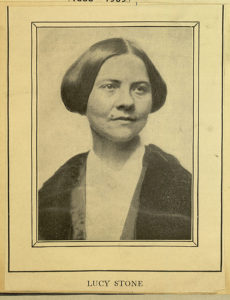 Lucy Stone launched the women’s rights movement in 1851, inspiring thousands to join the cause for women’s right to vote, work, receive an education, and own property. Susan B. Anthony and Elizabeth Cady Stanton were among her early followers. But after years of leading together, in 1869 Anthony and Stanton split from Stone, nearly causing the collapse of the movement. What happened?
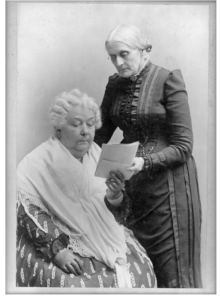 Anthony and Stanton were scandalized. But their differences didn’t stop there. “Stone was committed to campaigning at the state level; Anthony and Stanton wanted a federal constitutional amendment. Stone involved men in her organization; Anthony and Stanton favored an exclusively female membership. Stone sought to inspire change through speaking and meetings; Anthony and Stanton were more confrontational, with Anthony voting illegally and encouraging other women to follow suit.” (121)