I have a friend who says he’s not a patriot. You can’t love a country like the United States, he says, that has done so many horrendous things in the past (slavery and its treatment of Native Americans, to name two) and which continues its racism and bigotry in the present.
I have a second friend who acknowledges all that but who thinks that if our current form of government disintegrates, the results would be even worse. Indeed, she believes government still has an important role to play in helping America live up to its own dreams and aspirations.
Yet a third friend believes America has been called by God as a nation like Israel was. He is a nationalist who believes in the greatness of our Anglo-Protestant origins and touts America First.
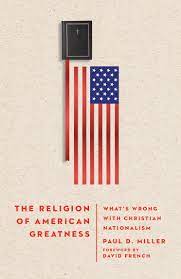 Paul D. Miller is none of these. He is a self-described conservative who stresses “the paramount value of human liberty within a framework of limited government” (p. 1). In The Religion of American Greatness Miller who served in the second Bush White House and is a professor at Georgetown, has written a profound critique of nationalism on political, historical, and biblical grounds. (He plans to write two more volumes—a critique of progressivism and a positive case for conservatism.)
In dealing with nationalism, Miller does not set up a straw man. In chapter 3 he gives ample space for the most thoughtful and articulate nationalists to have their say, including Samuel Huntington, Nigel Biggar, R.R. Reno, Rich Lowry, and Yarom Hazony. In summary, they believe that “preserving the United States’ Anglo-Protestant culture should be a major focus of public policy, even if and when it conflicts with the tenets of classical liberalism,* civic republicanism, and the American Constitution” (p. 58). Christian nationalists follow suit.
Miller then engages their arguments, focusing on “cultural nationalism, . . . not racial or theocratic nationalism, because it is a stronger argument and a more popular kind of nationalism and deserves a more careful and sensitive treatment.” Miller argues that humanity is not divisible into cultural units, as these nationalists contend. Therefore, the belief that political and cultural boundaries should overlap is essentially impossible. He contends “that the belief that government should have jurisdiction over culture is mistaken and dangerous” (p. 61).
In practice it would be folly to seek to enforce such a culture. “It is unlikely that the US government is competent to sustain, create, or orchestrate a common national cultural template for a nation of 320 million people when it can barely deliver the mail” (p. 102).
Neither does democracy depend on an Anglo-Protestant foundation. There are two dozen democratic countries in the world with no Christian heritage. Japan, India and South Korea are examples of the most stable and prosperous of these.
 Miller argues that nationalism does not create national unity, as its proponents contend. Rather Christian nationalism still has anti-democratic, illiberal tendencies, especially in how it treats ethnic and religious minorities. “Nationalism is the identity politics of the majority tribe. . . . It perpetuates the cycle of political warfare between nationalist majorities and identity-group minorities, each side . . . trying to seize state power and milk it for perks for their tribe” (p. 108).
Miller further unpacks how the Bible does not say what nationalists claim it says. “The civil religion that equates America with Israel is a prolonged exercise in missing the point. America is not Israel: the church is” (p. 130).
Ultimately, nationalism is idolatrous, supplanting loyalty to Jesus with loyalty to the nation. Evidence for this is seen in how many Christians disregard Jesus’ commands to “love your neighbor” and “love your enemies” if it serves their political goals.
Miller’s is an important and substantive book that will require substantive engagement by readers. But the reward will be equally substantive.
—
*By classical liberalism Miller does not mean left-leaning politics. Instead he uses it in its 18th-century sense of embodying the principles of liberty and equality on which the U.S. was founded, something both Republicans and Democrats say they support.

 What about this: “Scientific models don’t perfectly match observations so they can’t be relied on.” Which FLICC is this? You probably got this right away—it’s impossible expectations which demand unrealistic standards of certainty.
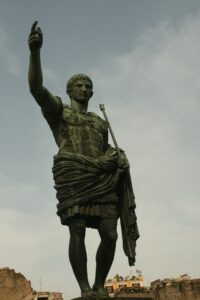 Jesus submitted to a Roman trial when he could have used his power (that is, he could have used violence) to stop it. He didn’t. Nonetheless, he refused to accept Rome’s authority as ultimate. God was the source of whatever authority the government had. While the government could act contrary to God, it was nonetheless responsible for its misdeeds and for failing to provide justice for the weak and oppressed.
 While the differences in Bible versions can be confusing, it’s important to remember the advantages. It means we have a variety of translations well suited for different purposes–some for public reading, some for study, and others for devotional reading. In addition, if we come across phrases like “holy kiss,” “with . . . a double heart,” “make their ears heavy”—we may be left a bit befuddled. By comparing different translations, we can sometimes get a better sense of the range of meanings in a text. 40 Questions charts dozens of translations along a continuum to show how they each wrestle with the balance of accuracy and readability in different ways.


 My friends were somewhat surprised at this. They thought the text said what it meant. No more oceans.
 Carmen Joy Imes, in
  Another traumatic event came in fifth grade. The teacher had us all stand around the perimeter of the room for a spelling bee. Somehow I was confident I would be standing a long time. My first word was swimming, and I knew I’d nail it. Only I spelled it with just one m, and in disappointment and shame I was told to sit down. I was stunned. How could that not be the right spelling ? To this day, I still wonder if that extra m is really necessary. Would anyone seriously be tempted to pronounce swiming with a long i?
 Is there a virtue in being a good speller for its own sake? I’m not sure. Is there value in memorizing the number pi to a hundred digits? Certainly as mental exercise. Perhaps not much more.