
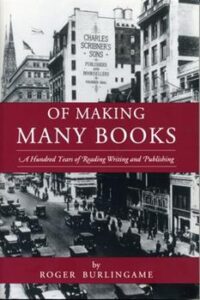
In 1996 Charles Scribner III wrote the introduction to a history of the publishing house whose name he shares.* Here are some quotations that show that the more things change in publishing, the more they stay the same.
On the Importance of Finding New Writers
In 1913 Charles Scribner’s only son, another Charles (III), graduated from Princeton and began his career in publishing. He was a contemporary of Perkins and Wheelock, and his age gave him a ready grasp of the importance of the new writers who were beginning to appear on the scene. (p. xviii)
 On the Importance of a Balanced List
I think it’s fair to say that by the 1950s the star-studded Perkins years had left an unfortunate legacy. The editors were on the perpetual lookout for the new Hemingway or Wolfe to arrive—like Godot. Their attention was fixed on the fiction front, to the exclusion of other areas of publishing. To restore some balance to the list–and a balanced list is essential to a publisher’s survival—Scribner set out to develop fields of nonfiction history, biography, how to books…. But Charles Scribner, Jr.’s own true love was for reference works, and these years saw the birth of works that have become the staple of every major school, college, and public library. (pp. xxiii-xxiv)
On Finding the New in the Old
In the context of my thumbnail history of Scribners very little of recent times is truly new; we were doing much the same a century ago. In effect, the postwar decades may be viewed as a recapitulation of earlier themes; that is to say, striking a balanced list, recognizing the importance of non-fiction, maintaining a backlist, bringing out series of books such as reference sets, and co-publishing with British firms. (p. xxiv-xxv)
For those in publishing looking for good ideas for the future, sometimes the best ones can be found in the past.
*The book is Of Making Many Books by Roger Burlingame, which (originally published in 1946) covers the first hundred years of Scribner’s. The book was reprinted fifty years later by the Pennsylvania State University Press.

 Two cows are standing in the field. One asks the other, “Are you worried about this mad cow disease going around?” The other relies, “Why should I be? I’m a helicopter.”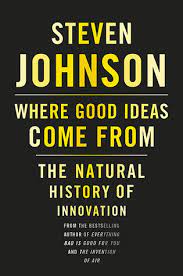
 In chapter 11 of
  Johnson also considers two ways ideas arise. One is in the “Eureka moment” that I focus on in Write Better. The second is “the slow hunch” pattern of idea generation. That is, we muse over a puzzling observation for a period of months or even years before a solution emerges in bits and pieces, rather than all at once. In either case, interacting with many different perspectives, subjects, and people is central to the solution.
  Many people fear public speaking more than death. Over years of speaking to small groups and rooms of hundreds, following certain practices have helped me prepare and be relaxed (ultimately allowing me to form a habit of speaking that has even made doing so spontaneously possible).
 That, however, while valid, can be a bit dull. Here’s another strategy. Extend the metaphor embedded in the cliché. Again, good, general advice but can I give an example? Yes, I can.
 Counterintuitively, limiting your audience can increase your readership. How? By making sure you go deeply into that narrow group. Writing successfully for all parents is hard because there are so many other resources and bestselling books already available. You might therefore get fewer readers for the broad audience than for the narrow one where there is less competition.
 Be alert, however, that not all graphic designers have the same training or experience. Someone expert at magazine covers or web pages may wrongly apply those design principles to a book page. They are not the same. Try to find someone who knows proper proportions for margins, line spacing (or leading), and so forth—for books.
 Unfortunately, the “singular they” has become so common that it is often used when it is just not necessary. Consider: