Leonardo da Vinci is best known for the Mona Lisa and The Last Supper. Yet it’s possible his achievements in science even outstripped those monumental paintings. A hundred years before Francis Bacon (the “father” of the scientific method), da Vinci pioneered key concepts in anatomy, geology, and fluid dynamics by the uncommon means of observation and experiment.
Perhaps the most extraordinary of all these was his investigation into how the human heart functioned. Remarkably, he made a glass model of a heart so he could better see how blood flowed. Some of his findings were not proven until five hundred years later. Even as late as 1960 scientists misunderstood some aspects. Only in 2014 was da Vinci conclusively shown to be correct.
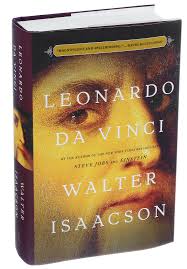
How did da Vinci manage to be hundreds of years ahead of his time in so many different areas of science? That is the story Walter Isaacson tells in his fascinating biography, Leonardo da Vinci. Isaacson’s other biographies also focus on some of the most creative minds in history—Benjamin Franklin and Steve Jobs—because Isaacson wants to know where inventiveness comes from and how to nurture it.
In his last chapter Isaacson offers a list of how we can all learn from Leonardo to be more creative. One is being collaborative. Da Vinci readily consulted with those who had expertise that he lacked, such as in anatomy and mathematics. He also cooperated, for example, with several colleagues in developing his Vitruvian Man which famously shows the proportions of a human figure inscribed in a circle and a square.
What Isaacson does not point out is that being in an urban setting enhances the possibilities of multiple connections which is the essence of creativity. Many recent studies have shown how social proximity, networking, and openness in cities can result in expanded creativity. The more people you can interact with, the more your own mind is stimulated. Da Vinci worked almost his entire adult life in the thriving centers of Florence, Milan, and Rome.
Isaacson also highlights the role of being interdisciplinary. Da Vinci was fascinated by almost everything—optics, neuroscience, aerodynamics, paleontology, and more. Like being collaborative, having many interests (and reading widely) makes possible many more fresh connections, stimulating new insights, and unexpected questions which, again, is at the heart of creativity.
These first two, being collaborative and interdisciplinary, allowed him to develop a habit of using analogy to understand what he observed. He saw eddies in water and by analogy correctly assumed there must be similar eddies in air movement. He even went further to suppose that curling locks of hair followed some of these same patterns. He also deduced from autopsies and other observations that eddies must occur within the bloodstream as blood circulates, even though the medical assumption of his day was that blood didn’t circulate but went back and forth.
Likewise he wondered if the principles by which trees branched was analogous to that of rivers and then to how blood vessels branch in a body. He was right about it all.
And if anyone is going to remember your work, writing everything down on paper is essential. No one is going to have your Facebook posts in fifty years. Da Vinci probably filled 35,000 pages of books with his notes, doodles, observations, sketches, and lists. While only about a fifth of these survive, if he hadn’t put things down on paper, we’d have none of his insights.
Not all his ideas were brilliant. Some were dead ends. But by being immensely productive, we increase the chances that something remarkable will emerge.
Sadly, his genius was hidden in those notebooks for centuries. Why? He never published and rarely finished paintings.* Therefore, only hundreds of years later did others unknowingly perform experiments and make discoveries that ended up replicating what he had done much earlier.
Why did he release so little to the public? He was a perfectionist and possibly ADHD, haphazardly following every shiny idea that flitted across his mind. He was too distracted to finish much and didn’t seem to care about sharing knowledge.
Ironically, the hyper-charged mind that so sidetracked him also made him incessantly curious about everything—which may have been his greatest strength. Did birds flap their wings faster on the downswing or the upswing? Why were fossils on top of mountains? Why do we see objects with slightly blurred edges instead of in sharp outline?
No, we can’t all be Leonardos. But we can be more creative at home, at work, in relationships, in gardening, in cooking, in writing by making one or two of his natural impulses into our habits.
_____
*Da Vinci even kept the Mona Lisa till his death, never turning the painting over to the patron who commissioned it (and was thus never paid) because he was forever tinkering with it.

 Some people in this country say our government is so bad it would be better to throw it away and start over. After all, things couldn’t get any worse. If we are tempted this Independence Day to think that we live in bad times, this story reminds us to be grateful for what we have—for things could be worse, much worse.
 In his book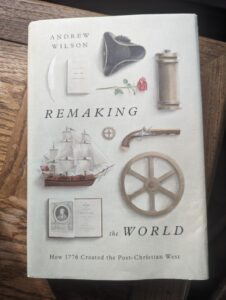
 Wilson closes with three Christian themes from the 1770s to help navigate the weird world that decade has bestowed on us.
 Today we live in what Tom Wolfe called the “Me Generation” and what David Brooks labeled in The Road to Character as the age of “the Big Me.” Yet, contrary to popular opinion, our sinful nature is, as Chesterton once observed, the only Christian doctrine that is empirically verifiable.*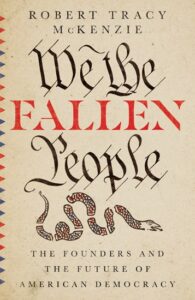
 While those of us who are committed Christians are clearly called to support the causes of justice, this should not be at the cost of bearing witness to the kingdom. Indeed, many conservative Christians claim that the most important thing they can do is spread the gospel of Jesus Christ. Yet they seem quite willing to sacrifice that on the altar of political power.
 Another problem he spotted is also eerily familiar. Elected officials regularly offered simplistic answers which cannot hold in the face of complex problems. “An idea that is clear and precise even though false,” Tocqueville observed, “will always have greater power in the world than an idea that is true and complex” (p. 194). That is so whether the ideas come from the right or the left.
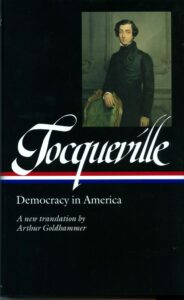 Alexis de Tocqueville’s classic