In December 2000 a story appeared in several British newspapers, including The Guardian, about a man in New York, George Turklebaum, who had been dead at his office desk for five days . . . and no one noticed! Coworkers at “the publishing-services company” often passed by his cubicle and said hi without it registering that he hadn’t responded. “We just assumed that George was taking time to go over the text very carefully, as he always did,” said his boss.
 Anything sound odd to you about that story? Anything odd besides a man being dead in an office for five days without anyone noticing?
Anything odd like, “Why did British papers report about a man being dead in New York instead of New York papers?”
Or odd like, “Why was the publishing-services company not named?”
Or odd like, “Wouldn’t a body start stinking to high heaven long before five days?” (Spoiler alert: it would.)
You’ve probably heard this story or variations of it which have circulated for at least the last twenty years. The truth is, it was first published by an American tabloid, the Weekly World News, which also publishes such important stories as “Newest U.S. Judge is 5-Years Old,” and “The Yeti Is Behind Cryptocurrency,” and former Vice President “Mike Pence Is a Cyborg.”* You get the idea.
The only source of this report for all the British newspapers, even for one as highly reputable as The Guardian, was the tabloid. There was no other corroborating evidence.
When David Mikkelson did some research at Snopes, he found that no one named George Turklebaum was listed in the Social Security Death Index, and the New York Medical Examiner’s office had no information on the death of anyone named Turklebaum for 1999 or 2000.**
Yet so many of us hear stories like this one about the dead office worker, and we think, “Weird. But I can actually see that. Don’t we all feel like nameless cogs in a machine sometime?”
We take it in, often uncritically. Yet right on the surface are aspects that should make us question what’s going on. Not just a rotten corpse, but the lack of specifics (like the company’s name) and of sources (like a police report).
The key word is uncritically. We don’t stop to question. Thinking critically about what we read or hear doesn’t mean being critical in the sense of finding fault. It means asking questions.
To some extent it doesn’t matter what questions we ask. Almost any question will do. The point is to ask a question and not stay on autopilot.
The question can come at the beginning, the middle, or the end. It can be profound or prosaic. Regardless, doing so engages us. We become actors in the drama, dialogue partners in the conversation, friends in the relationship. We are not merely passive receptacles into which entertainment, advertisements, opinions, information, or disinformation are poured.
Many people (including those we agree with) want to sway us for their own purposes. Nurturing the habit of asking questions about what we hear or read can, among other benefits, provide us with a vaccine against the virus of being manipulated by others.
—
*These are actual headlines from https://weeklyworldnews.com/, accessed January 28, 2021.
**David Mikkelson, “Man Dies at Desk,” Snopes, https://www.snopes.com/fact-check/working-stiff/. See also https://www.truthorfiction.com/deadatwork/.
Image by David Mark from Pixabay

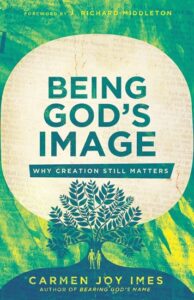 Carmen Joy Imes, in Being God’s Image, lands exactly where Genesis 1 does in the very next verse. God gave the first man and woman in the garden a calling to be fruitful, to multiply, and to subdue the earth (Gen 1:28). The image of God is not a character trait nor an innate capacity. Rather it is a role, a responsibility. God calls us to be his vice regents for the world he has created.
 Another traumatic event came in fifth grade. The teacher had us all stand around the perimeter of the room for a spelling bee. Somehow I was confident I would be standing a long time. My first word was swimming, and I knew I’d nail it. Only I spelled it with just one m, and in disappointment and shame I was told to sit down. I was stunned. How could that not be the right spelling ? To this day, I still wonder if that extra m is really necessary. Would anyone seriously be tempted to pronounce swiming with a long i?
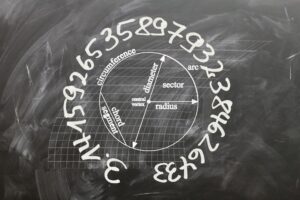 Is there a virtue in being a good speller for its own sake? I’m not sure. Is there value in memorizing the number pi to a hundred digits? Certainly as mental exercise. Perhaps not much more.
 Then Cooper said, “Can I ask a question? Do you feel you are entitled to the truth?”
 Riders are not mere lackies. They can learn new types of thinking (math, logic, technology, etc.) and explore alternatives which can help the elephant avoid disaster. “And most important,” as Haidt wrote in
  We rotate hosting our get-togethers, with the hosts selecting the book and leading the discussion. Without trying, our books (and occasional movies) have been split almost evenly between fiction and non-fiction. We’ve enjoyed history, science fiction, mystery, memoir, classics, and current best-sellers.
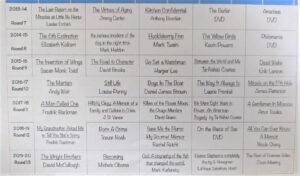 I prefer our system of making selections over voting as a group which can result in choosing everyone’s second or third choice. That could also keep the range much more narrow and perhaps less challenging to our own tastes or viewpoints. I enjoy being stretched by the personal selections of my friends.