I have a one-question survey that will reveal with near perfect accuracy whether or not you are an individualist. Set? Here it is: Would you readily consider allowing your parents to arrange a marriage for you?
Those of us from a Western culture would never give this the slightest bit of serious consideration. But in collectivist cultures (which make up the majority of the world), people answer yes to this all the time.
Or perhaps slightly less dramatically, what about this? Would you expect your extended family to decide where you go to college? Maybe your nuclear family but definitely not your extended family. Right? Yet this is common in Latino/a and Asian societies.
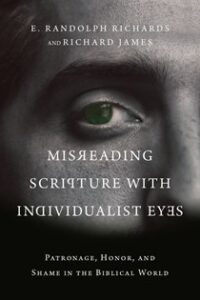 For individualists, a collective culture is, well, like being in a foreign country. And that’s why, as the authors of Misreading Scripture With Individualist Eye contend, we so often misunderstand the Bible which comes out of collective cultures. We persistently read it through the lens of our own individualistic mindset.
With many stories of their own experiences in the Middle East, Asia, and elsewhere, the authors unpack how kinship, patronage, brokering, honor, shame, and boundaries are all hidden in plain sight in the Bible. A few examples.
Why does Matthew spend all that time laying out Jesus’ genealogy? Because honor often comes from your family, your family’s history, who you are related to. To be descended from Abraham and David brings great honor (Mt 1:1).
Why does Nicodemus come alone at night to talk with Jesus? Not because he feared the other Pharisees. Rather he didn’t want to inadvertently shame Jesus publicly by asking a question that might be seen as a challenge to a teacher he clearly respected (Jn 3:2).
When Jacob gives Rachel’s son, Joseph, the multicolored coat, the other sons aren’t jealous because he got a better Christmas gift? No. It was much more serious. They realized this meant Joseph was going to be treated as the first-born and get their father’s inheritance. They were angry that their side of the family (all being sons of Leah) would be dependent on Joseph’s generosity, which seemed unlikely from this arrogant kid. This is not an individual’s rags-to-riches story. It is a story of kinship and family reconciliation. Both sides forgive the other for the wrongs they did.
The discussion on shame is especially illuminating because we often only have one definition of shame, and it’s bad—something to always be avoided. But in Scripture and much of the world, there is also a good kind of shame that seeks to nudge people in the community back into proper behavior. It’s kind of like our conscience. Having a sense of shame beforehand can keep us from acting wrongly, not just feel bad after acting wrongly. The book offers multiple examples of when shame creates a path for restoration—which is good shame. When it seeks to exclude and cut others off, that is bad shame.
 From a Western perspective, we might see patronage as creating unhealthy dependence, even being oppressive. But those inside see it as providing protection, meeting needs, giving security. Yes, it can be abused, but the problem then is not the system but the people in it.
Our lack of a corporate sense can minimize our commitment to the church and even to family that the Old and New Testaments assume. I am not just saved, you see. The Bible says I am also saved into a community.
The point of the book is not to expunge our individualism. That wouldn’t be possible in any case. Rather, we have much to learn about what the Bible is really saying by putting on collectivist glasses. And we have much to learn about living biblically from our brothers and sisters in the faith who come from such backgrounds.
—
I received a prepublication complimentary copy of this book from the publisher. The opinions here are my own.
credit: Joseph Redfield Nino from Pixabay
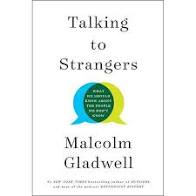
 Gladwell begins and ends the book with the story of Sandra Bland, the 28-year-old African American who in 2015 was stopped for a minor traffic infraction, arrested, and committed suicide in jail three days later. He methodically unpacks the recorded July 10 encounter with State Trooper Brian Encinia.
 After some time, and having wasted everything, he is destitute and starving. In desperation he decides to return to his father, thinking to make an abject apology and ask for mercy.
  Normally I don’t suggest self-editing before we start drafting. That can often shut down our flow. Unless you usually find yourself writing 3,000 words for every 1,000 assigned, it’s best to cut afterward. But how? A few things come to mind.
 Fourth, in nonfiction you will often have main points. Sometimes you’ll have subpoints as well. But if you find you have sub-subpoints, those are likely candidates to ax.
  1. Read more. All the books were waiting that I’ve wanted to get to that I hadn’t had time for.
 My wife, Phyllis, needed to do it differently. She is such an activist I suggested she not make a plan or any long-term commitments for a year. Otherwise she would fill up her schedule without a clear sense of priorities. And I knew she would have plenty to do during that year, but she needed to organically see what her new rhythm of life would be. So she did. She spent the year continuing to be active with friends, family, discussion groups, and service opportunities. But no big plans.
 That might not even solve all your problems. After all, sending a message into the future can be a tricky business. What could make sure that it didn’t degrade as it passed through the space-time continuum? The technology could break down. Human error or human limitations could prevent the message from being transmitted. And because language and culture change significantly over time, our words and syntax could be difficult to understand by those in the future.
 Writing and reading are so commonplace we forget how almost magical the whole process is. We can receive and send ordinary and exceptional stories as well as knowledge across thousands of miles and hundreds of years with people we have never met and who may not know our language.


 1. Get
  4. Play